
Dawlance Inverter vs Non-Inverter AC: Which One Should You Buy?
Choosing between a Dawlance inverter ac and non-inverter air conditioner can be confusing, especially when both options offer effective cooling and the non-inverter model has a lower purchase price.
The main difference lies in how the compressor operates. A non-inverter AC normally runs its compressor at a fixed speed. It switches on when the room becomes warm and switches off after reaching the selected temperature. An inverter AC can adjust compressor speed according to the cooling requirement instead of repeatedly operating only at full capacity.
This difference affects electricity consumption, temperature stability, noise, initial price, maintenance cost, and long-term comfort.
What Is a Dawlance Inverter AC?
A Dawlance inverter AC uses a variable-speed compressor. The compressor can increase or reduce its operating speed according to the room temperature.
When the room is very hot, the AC can operate at a higher output to bring the temperature down. Once the room approaches the selected setting, the compressor slows down and continues operating at a lower level.
This reduces repeated compressor starts and stops. Variable-speed systems can operate closer to the actual cooling demand, helping maintain a more consistent temperature while reducing unnecessary on-and-off operation.
What Is a Dawlance Non-Inverter AC?
A Dawlance non-inverter AC uses a fixed-speed compressor.
When the room temperature rises above the selected level, the compressor switches on and normally operates at full capacity. Once the room reaches the required temperature, the compressor switches off. It starts again when the room becomes warm.
This operation is simple, but it creates repeated starting cycles and more noticeable temperature changes.
Dawlance’s current official non-inverter split AC page lists the Infinity Pro series in 1 Ton and 1.5 Ton capacities. Both models are cooling-only units with rotary compressors and Gold Fin protection.
Dawlance Inverter vs Non-Inverter AC: Main Differences
Compressor Operation
The compressor is the most important difference between the two systems.
A Dawlance inverter AC changes compressor speed depending on how much cooling the room requires. It can operate at high output during startup and then reduce its speed after reaching the selected temperature.
A non-inverter AC operates more like an on-and-off system. The compressor normally runs at full speed and then stops completely.
The inverter system is more flexible because it can match its to changing room conditions. A non-inverter system has a simpler fixed-speed operation.
Electricity Consumption
Electricity consumption is one of the main reasons people choose an inverter AC.
Once an inverter AC has cooled the room, it can reduce compressor speed and use less power to maintain the temperature. It does not need to restart at full capacity every time the room becomes slightly warm.
A non-inverter compressor repeatedly switches on at full power. These starting cycles can create higher short-term electrical demand and may result in greater overall consumption during long daily use.
Dawlance also states that inverter models can help users manage summer and winter electricity bills through inverter technology.
However, an inverter AC does not guarantee a low bill in every situation. Consumption still depends on:
- AC capacity
- Room size
- Outdoor temperature
- Thermostat setting
- Room insulation
- Daily running hours
- Number of occupants
- Filter condition
- Installation quality
- Frequency of door opening
An undersized inverter AC that runs continuously at maximum output can consume more electricity than expected.
Cooling Speed
Both inverter and non-inverter Dawlance ACs can provide strong initial cooling.
A non-inverter AC starts at full compressor capacity, so it can feel powerful immediately after being switched on.
An inverter AC can also operate at high output when the room is hot. After reaching the desired temperature, it reduces compressor speed instead of completely switching off.
Temperature Stability
An inverter AC usually keeps the room temperature closer to the selected setting.
For example, when the temperature is set to 24°C, the inverter compressor can slow down as the room approaches that level. It continues making small adjustments to maintain comfort.
A non-inverter AC may cool the room below or close to the selected setting, switch off, and then allow the room to become warmer before switching on again.
These temperature changes may be more noticeable during sleep or long working hours.
People who want stable cooling in bedrooms, offices, study rooms, or living areas may find an inverter model more comfortable.
Noise Level
Inverter ACs are generally quieter after the room reaches the selected temperature because the compressor and fans can operate at reduced speed.
A non-inverter unit repeatedly switches its compressor on and off. The startup sound and change in operation may be more noticeable, particularly at night.
Noise also depends on the installation, outdoor-unit placement, fan setting, mounting condition, and maintenance of the unit.
An incorrectly installed inverter AC can still produce vibration or unusual sound.
Voltage Fluctuation
Both inverter and non-inverter ACs require a stable and properly wired electrical supply.
Some modern Dawlance models support low-voltage operation, but the supported voltage range depends on the exact model.
An inverter AC contains more sensitive electronic components, especially the PCB. Sudden voltage surges, poor earthing, loose wiring, and severe fluctuations can damage these components.
A non-inverter unit may have simpler electronics, but its compressor also draws a stronger starting current whenever it switches on.
Heating Function
Most current Dawlance inverter models are reversible, meaning they can provide cooling during summer and heating during winter. The official inverter catalogue currently shows a large number of reversible models.
The current Dawlance Infinity Pro non-inverter split models are listed as cooling-only units.
For customers who want one appliance for summer and winter, an inverter heat and cool model is the better option.
Features and Technology
Dawlance inverter models generally offer a wider selection of modern features.
Depending on the model, these may include:
- T3 compressor
- Heat and cool operation
- Self-cleaning
- Gold Fin protection
- Sleep mode
- Turbo or fast cooling
- Low-voltage operation
- Wi-Fi or smart connectivity
- Multidirectional airflow
- Special air filters
- Memory resumption
The current inverter catalogue shows Gold Fin protection across the listed range and self-cleaning on many models.
The Infinity Pro non-inverter models offer simpler features, including Gold Fin protection, sleep mode, timer, auto restart, and filtration.
A non-inverter AC may therefore suit buyers who want basic cooling without paying for additional technology.
Dawlance Inverter vs Non-Inverter AC Comparison
Feature | Dawlance Inverter AC | Dawlance Non-Inverter AC |
|---|---|---|
Compressor | Variable speed | Fixed speed |
Operation | Adjusts output according to demand | Switches fully on and off |
Initial price | Usually higher | Usually lower |
Electricity use | Generally better for long daily use | Can cost more during extended use |
Temperature control | More stable | More noticeable fluctuations |
Noise | Usually quieter after cooling | Compressor starts may be more noticeable |
Cooling | Strong and adjustable | Strong fixed-speed cooling |
Heating | Available on many models | Current Infinity Pro models are cooling-only |
Features | Wider selection | More basic |
Repair cost | Major electronic repairs may cost more | Simpler system may be cheaper to repair |
Best for | Regular and long-duration use | Occasional and short-duration use |
Dawlance Inverter and Non-Inverter AC on Installments
Both inverter and non-inverter air conditioners can require a significant upfront payment.
Installment plans allow buyers to spread the cost over several months. This may make an inverter model more accessible to customers who want better long-term energy management but cannot pay the full price at once.
Before selecting an installment plan, check:
- Cash price
- Advance payment
- Monthly installment
- Number of months
- Total payable amount
- Processing charges
- Required documents
- Late-payment terms
- Delivery charges
- Installation cost
- Warranty coverage
Why Buy From a Trusted Store?
An air conditioner is a long-term purchase, and problems caused by incorrect installation or unclear warranty documentation may appear after the sale.
A trusted retailer should provide:
- Original Dawlance product
- Proper invoice
- Correct model details
- Matching indoor and outdoor units
- Warranty documentation
- Installation guidance
- Clear payment terms
- Delivery information
- After-sales support
Before accepting delivery, compare the model number on:
- The invoice
- Indoor unit
- Outdoor unit
- Product cartons
- Warranty card
FAQs
1. What is the main difference between a Dawlance inverter and non-inverter AC?
An inverter AC adjusts compressor speed according to the cooling requirement. A non-inverter AC runs at a fixed speed and repeatedly switches the compressor on and off.
2. Which Dawlance AC uses less electricity?
A correctly sized inverter AC generally uses electricity more efficiently during long daily operation because it can reduce compressor speed after the room reaches the selected temperature.
3. Is a Dawlance non-inverter AC cheaper?
A non-inverter AC normally has a lower purchase price. However, it may cost more to operate when used for several hours every day.
4. Which AC is better for a bedroom?
An inverter AC is usually better for a bedroom because it offers more stable temperature control, quieter operation, and better energy management during long use.
5. Does a Dawlance non-inverter AC provide good cooling?
Yes. A correctly sized non-inverter AC can provide effective cooling. The main differences are electricity management, temperature fluctuation, features, and operating style.
Conclusion
The choice between a Dawlance inverter and non-inverter AC depends mainly on usage and budget.
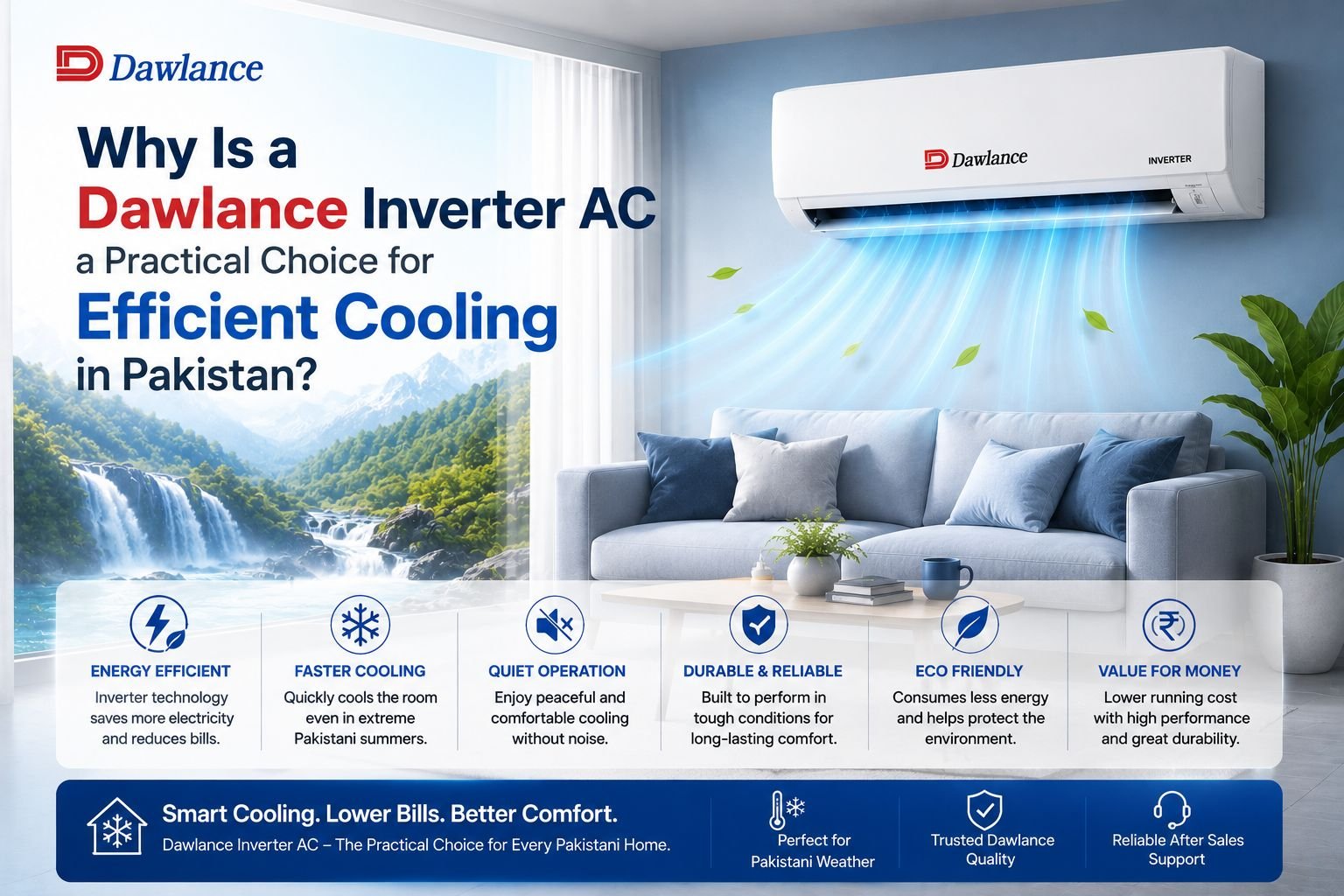
A Dawlance inverter AC costs more initially but offers variable-speed operation, steadier temperature control, quieter performance, more features, and better electricity management during extended use.


0 Comments